Schema for AI Overviews: What Actually Matters (2026)

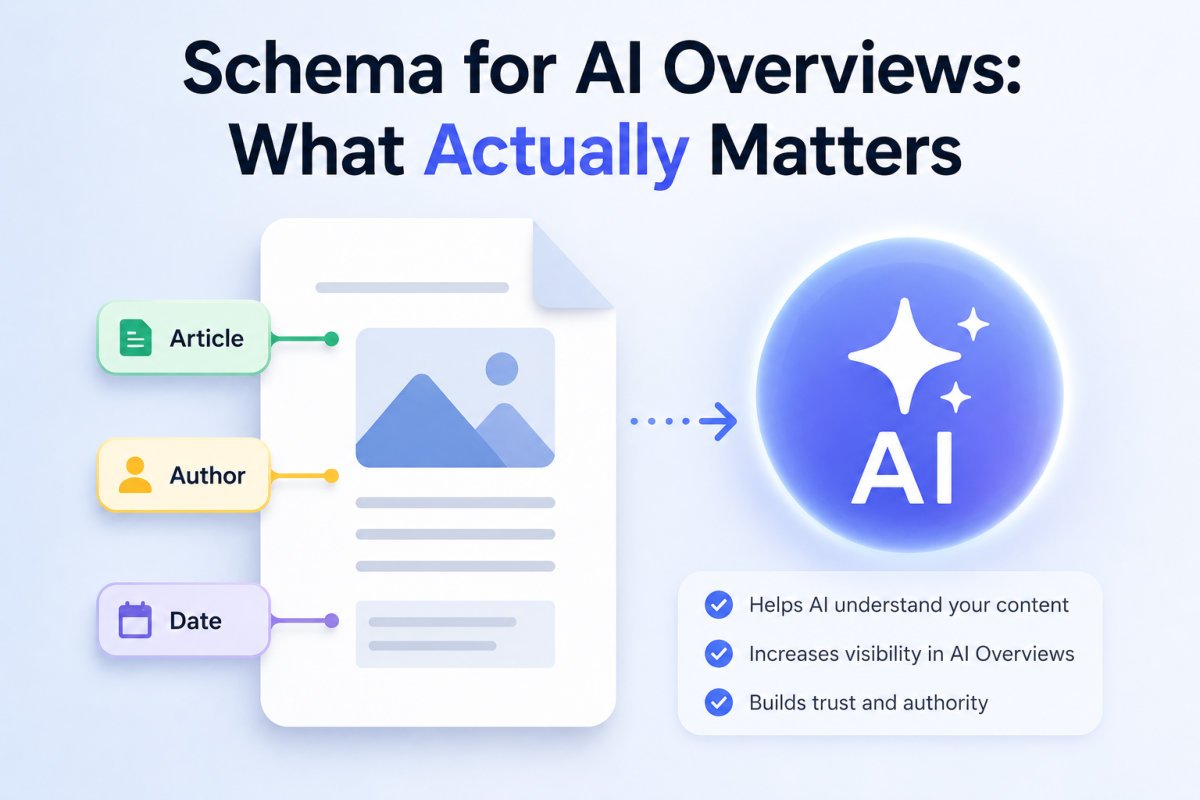
The schema types that genuinely help with AI Overviews and AI citation are Article (with author, datePublished, and dateModified), Person (tied to a real author bio page), Organization, and Breadcrumb, these establish who published something, when, and how it fits into your site’s broader structure. FAQPage schema no longer earns a visible rich result in Google Search, but it’s still worth keeping if your content has genuine Q&A sections, AI systems now read it primarily as a trust and context signal, not a display trigger. The rule that matters most: your schema must accurately match what’s actually visible on the page, mismatches are a real red flag AI systems can detect.
Before You Start
Make sure you have the following in place first:
- An SEO plugin already generating basic schema (see our Rank Math setup guide)
- A real author or Organization identity to attach to your content, schema works best when it describes something genuinely real, not a placeholder
Schema markup used to be judged almost entirely by one question: does it earn a rich result in search? That question has narrowed. In 2026, AI systems read schema differently than Google’s traditional search results display ever did, and that changes which schema types are actually worth your attention.
What You’ll Learn
- Which schema types genuinely matter for AI citation, and why
- What changed for FAQPage schema specifically, and why it’s still worth keeping
- The one implementation rule that matters more than which schema types you use
- How to check what’s already in place on your site
The Schema Types That Actually Matter
Article Schema
Tells AI systems what a piece of content is, who wrote it, when it was published, and when it was last updated. The dateModified property is genuinely underused, AI systems favor recent, well-maintained content, and this is the explicit signal that communicates it.
Person Schema
A properly marked-up author, tied to a real author bio page, adds a real layer of credibility. This is part of why a genuine About page and author bio (not a generic “admin” byline) matters beyond just being good practice, it’s structured data AI systems can actually use.
Organization Schema
Establishes your site or brand as a real, identifiable entity, not just a collection of anonymous pages.
Breadcrumb schema
Communicates where a page sits within your broader content structure. This is less about earning a citation directly and more about entity context, a page nested clearly under a related topic cluster is easier for AI to place accurately than one that appears to exist in isolation.
What Changed for FAQPage Schema
As covered in our Rank Math vs Yoast comparison, Google retired FAQ rich results from search in May 2026. Google’s March 2026 core update went further, narrowing rich result eligibility specifically for FAQ, Review, and How-To schema on pages where it wasn’t clearly tied to genuine primary content, essentially closing the door on using FAQ schema purely to grab extra search real estate.
Here’s the important nuance: Google hasn’t confirmed a direct link between FAQPage schema and AI citation specifically. But if your page genuinely has real Q&A content, keeping the markup remains a reasonable part of an AI optimization approach, the value has simply shifted from “display trigger” to “trust signal AI Mode uses to verify and contextualize claims during answer synthesis.”
WebGomu Tip: Don’t add FAQ sections to a page specifically to gain schema real estate anymore, that use case is genuinely gone. Only include FAQ schema where the content is real, useful Q&A your reader would actually want answered, exactly the standard your own content already follows.
The Rule That Matters More Than Any Schema Type
Your schema must accurately match what’s actually visible on the page. If your Article schema states a publish date that doesn’t match what’s shown on the page, that inconsistency is detectable, and AI systems are increasingly able to catch it. A mismatch doesn’t just fail to help, it actively undermines trust in the rest of your structured data.
How to Check What’s Already in Place
- Run Google’s Rich Results Test on a handful of your key pages.
- Confirm Article, Person, and Organization schema are present, not just FAQPage.
- Check that optional properties (author, image, dateModified) are filled in, not left blank, these give AI systems more context to cite confidently rather than skip your content.
Common Mistakes
- Only implementing FAQPage schema while skipping Article, Person, and Organization schema.
- Leaving optional schema fields blank, they’re what give AI systems the confidence to actually cite your content.
- Letting schema data drift out of sync with what’s actually visible on the page.
- Adding FAQ sections purely to gain search real estate, a practice that no longer has the payoff it once did.
Recommended Tools
- Rank Math — generates JSON-LD schema (the recommended format) automatically, including Article and FAQ types, covered in our setup guide
- Google’s Rich Results Test — free, the direct way to check what schema is actually live on a given page
Key Takeaways
- Article, Person, Organization, and Breadcrumb schema matter more for AI citation than FAQPage alone.
- FAQPage schema is still worth keeping for genuine Q&A content, its value has shifted to a trust signal, not a display trigger.
- Schema must match visible page content exactly, mismatches are a detectable red flag.
- Fill in optional schema properties (author, dateModified, image), they’re what give AI systems confidence to cite rather than skip.
Frequently Asked Questions
Is FAQPage schema still worth using in 2026?
Yes, for genuine Q&A content. It no longer earns a visible rich result in Google Search, but it still functions as a trust and context signal AI systems can use when deciding what to cite.
What’s the most important schema type for AI Overviews?
Article schema, with a properly filled-in author, datePublished, and dateModified, is generally considered the foundation, it establishes what the content is and how current it is.
Does mismatched schema hurt my site?
It can. If schema data doesn’t match what’s actually visible on the page, AI systems can detect the inconsistency, which undermines trust in the content rather than helping it get cited.
Do I need to write custom code to add schema?
No, an SEO plugin like Rank Math generates schema automatically in the recommended JSON-LD format, no custom coding required for standard implementation.
Should I add FAQ schema to every page to improve AI visibility?
No, only add it where the content genuinely includes real Q&A a reader would want answered. Adding it purely to gain schema coverage doesn’t reflect genuine content and offers little real benefit.
Resources Links
Author:

Christoper Enolpe
Founder of WebGomu • WordPress Freelancer with 10+ Years of Experience
Christoper is the founder of WebGomu and a WordPress freelancer with over 10 years of hands-on experience building, optimizing, and maintaining WordPress websites. He writes practical, beginner-friendly guides based on real-world experience, covering WordPress, SEO, website performance, and AI tools to help readers build better websites with confidence.
Learn more: https://webgomu.com/about/
Get one WordPress tip every week
Start Here
The Ultimate Beginner’s Guide to WordPress (2026): Build Your First Website Without Coding
Popular Guides
Our Partner
More from the blog

AI Photo Editing Tools for WooCommerce Product Photos (2026)
Best WordPress SEO Plugins 2026: Compared & Ranked