Best AI Content Generators for WordPress: A Comparative Review


The AI content generator space for WordPress is genuinely crowded, and a lot of what ranks well is vendor marketing dressed up as independent comparison. Before picking a tool, two distinctions matter more than any single feature list: whether it’s a bring-your-own-API-key plugin (you pay the plugin license plus your own OpenAI, Anthropic, or Google account directly) or a bundled subscription, and whether it’s a pure text generator or an AI agent that can take action inside your site. Established, well-integrated options like AI Engine, Jetpack AI Assistant, Rank Math’s AI features, and Elementor AI remain the most reliably reviewed choices, genuinely newer tools are harder to evaluate honestly given how much of their own marketing dominates the search results about them.
Before You Start
Have a specific content task in mind before evaluating tools, blog drafts, product descriptions, meta text, these have genuinely different requirements, and the “best” tool depends heavily on which one you’re actually solving.
Search “best AI content generator for WordPress” and you’ll find dozens of nearly identical listicles, several written by the companies selling the tools being ranked. That’s worth knowing going in, not as cynicism, just as context for reading any comparison in this space with a healthy amount of skepticism, including this one.
What You’ll Learn
- Two categories worth understanding before comparing any specific tool
- The real cost structure behind “free” and subscription-based options
- How the established, verifiable options actually compare
- An honest, well-known quality problem worth planning around
Two Categories Worth Understanding First
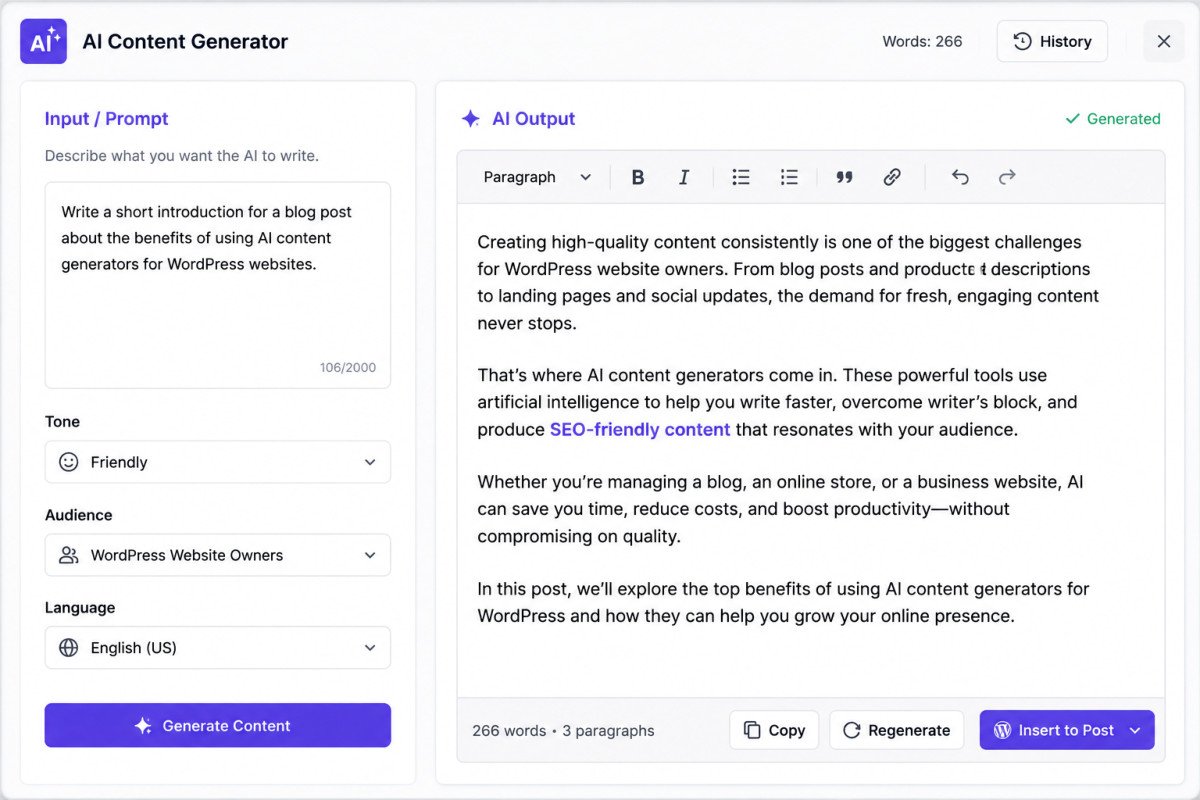
Not every “AI content generator” does the same job. Generators take text in and give text out, drafting, rewriting, summarizing, a genuinely useful category for writing assistance. Agents go further, connecting to your actual site and taking multi-step action, auditing content, applying fixes, publishing directly. Most tools marketed broadly as “AI content generators” fall into the first category. Knowing which one you’re actually evaluating prevents comparing two genuinely different kinds of tools as if they were interchangeable.
The Real Cost Structure
This matters more than the sticker price. Bring-your-own-key tools charge a plugin license (often $0-60/year) but require you to separately fund an OpenAI, Anthropic, or Google account, actual usage costs happen there, not through the plugin. Bundled subscriptions fold AI usage into a single monthly fee, more predictable, but usually more expensive overall. For a typical blog publishing 10-20 articles a month, bring-your-own-key API costs commonly run $5-20/month on top of any plugin license, worth factoring into a genuine cost comparison rather than looking at plugin price alone.
Comparing the Established Options
| Tool | Category | Pricing Model |
|---|---|---|
| AI Engine | Generator, broad multi-model support | Bring-your-own-key |
| Jetpack AI Assistant | Generator, native Gutenberg integration | Usage-based, bundled through Jetpack |
| Rank Math AI | Generator, SEO-integrated suggestions only | Limited free credits, paid tiers add more |
| Elementor AI | Generator, page-builder-integrated | Bundled with Elementor AI credits |
Worth noting a real limitation with SEO-plugin-integrated AI specifically: it typically suggests titles, meta descriptions, and outlines for you to apply manually, rather than generating full, publish-ready content on its own. That’s a genuine feature, not a flaw, but worth knowing if you expected a full drafting tool.
The Honest Quality Problem Worth Knowing
This is a well-known, widely acknowledged issue across the category, not specific to any one tool: default AI output frequently reads as confident but generic, technically fluent paragraphs that don’t actually say anything specific or genuinely useful. This isn’t a reason to avoid these tools, it’s a reason to treat every output as a first draft requiring real editing, added specifics, and genuine fact-checking before publishing, the same standard that applies to any AI-generated content regardless of which tool produced it.
WebGomu Tip: Test any content generator on a task you already know well enough to judge the output critically, not a topic you’re unfamiliar with. It’s much easier to spot generic, hollow AI writing when you already know what a genuinely good answer looks like.
Common Mistakes
- Trusting a “best AI content generator” ranking without checking whether the source has a financial stake in the results.
- Comparing a bring-your-own-key tool’s plugin price directly against a bundled subscription’s price without factoring in actual API usage costs.
- Confusing a text generator with a full AI agent, and expecting autonomous site management from a tool built only to draft text.
- Publishing default AI output without a genuine editing and fact-checking pass.
Key Takeaways
- Understand whether a tool is a text generator or a full AI agent before comparing it against others.
- Bring-your-own-key pricing looks cheaper upfront but includes real, ongoing API costs, factor in the full picture.
- Established, well-integrated options remain the most reliably evaluable choices in a genuinely noisy, marketing-heavy category.
- Generic, hollow default output is a known, common issue across the category, plan for a real editing pass regardless of which tool you choose.
Frequently Asked Questions
What’s the difference between an AI content generator and an AI agent?
A generator takes text in and produces text out, drafting or rewriting content. An AI agent goes further, connecting to a site and taking multi-step action directly, like auditing content or publishing changes, a meaningfully different category of tool.
Is bring-your-own-API-key pricing actually cheaper than a bundled subscription?
It depends on usage. The plugin license itself is often cheaper or free, but real API costs, commonly $5-20/month for a typical blog, apply on top, worth comparing the full cost, not just the plugin price.
Why does AI-generated content sometimes read as generic?
This is a well-known, common issue across the category, not specific to any single tool, default output can be technically fluent but lack genuine specifics. Treating it as a first draft requiring real editing addresses this directly.
Can an SEO plugin’s built-in AI generate full articles on its own?
Typically not fully, most SEO-integrated AI features suggest titles, meta descriptions, and outlines for manual application, rather than producing complete, publish-ready content independently.
How should I evaluate “best AI content generator” rankings I find online?
With real skepticism about the source, many rankings in this space are published by the companies selling the tools being ranked. Cross-checking against established, independently verifiable tools is a more reliable approach.
Resources Links
- The Ultimate Beginner’s Guide to WordPress (2026)
- AI for WordPress: The Complete 2026 Guide
- Best AI Plugins for WordPress
- How to Use AI with WordPress: A Beginner’s Guide
- How to Generate Blog Posts with AI
- How to Optimize WordPress for AI Search
- Schema for AI Overviews
- AI Chatbots for WordPress
- How to Set Up Rank Math SEO the Right Way
- Elementor vs Gutenberg: Which Page Builder Should You Use?
Author:

Christoper Enolpe
Founder of WebGomu • WordPress Freelancer with 10+ Years of Experience
Christoper is the founder of WebGomu and a WordPress freelancer with over 10 years of hands-on experience building, optimizing, and maintaining WordPress websites. He writes practical, beginner-friendly guides based on real-world experience, covering WordPress, SEO, website performance, and AI tools to help readers build better websites with confidence.
Learn more: https://webgomu.com/about/
Get one WordPress tip every week
Start Here

The Ultimate Beginner’s Guide to WordPress (2026): Build Your First Website Without Coding
Popular Guides
Our Partner

More from the blog

AI Photo Editing Tools for WooCommerce Product Photos (2026)
AI for WordPress: The Complete 2026 Guide