Rank Math vs Yoast SEO: Which Should You Choose in 2026?

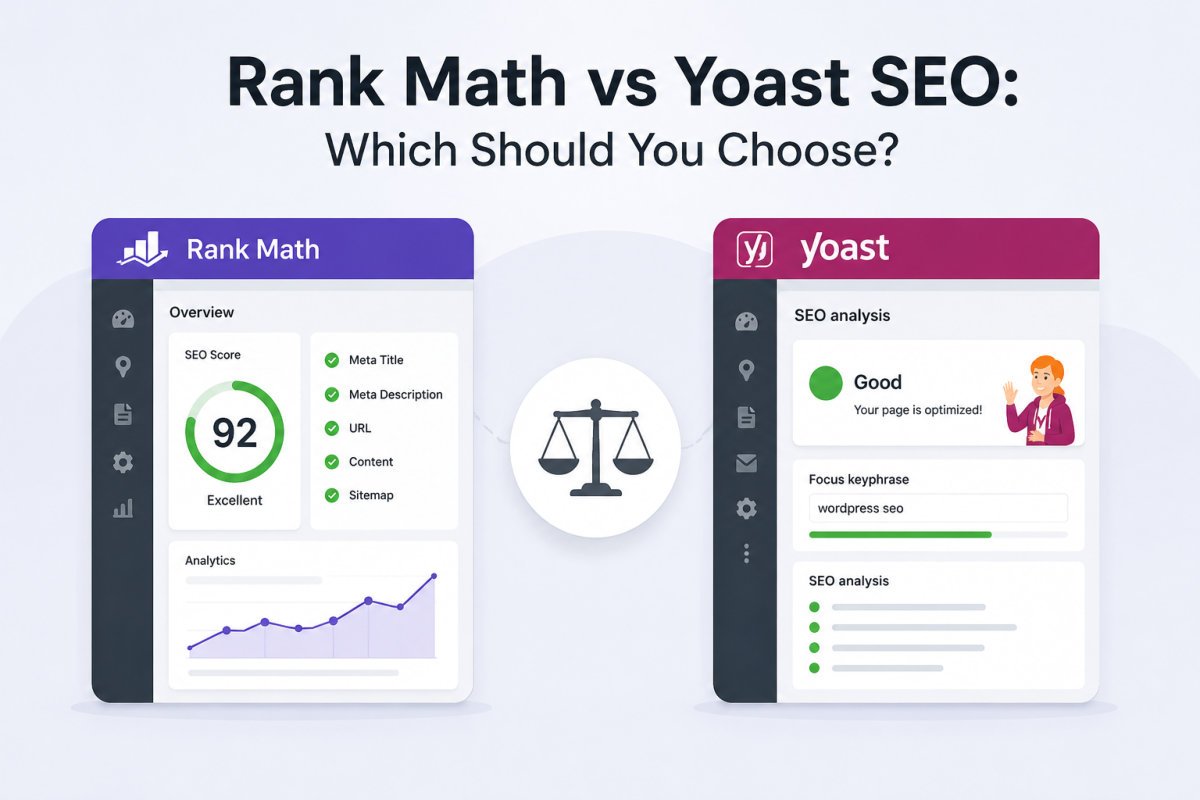
Rank Math‘s free version is significantly more generous than Yoast’s, including multiple keyword analysis, a redirect manager, 404 monitoring, and 18+ schema types at no cost, features Yoast reserves for its paid tier. Yoast remains the simpler, more guided option for absolute beginners who want hand-holding over raw feature count. On pricing, Rank Math’s paid plan covers unlimited personal sites starting around $59/year, while Yoast charges per site and sells specialized SEO add-ons separately, costs that add up fast if you need more than the basics.
Before You Start
If you haven’t installed an SEO plugin yet, see our Rank Math setup guide for a full walkthrough, this comparison assumes you’re deciding between the two, or reconsidering a plugin you’re already using.
Rank Math and Yoast are the two most recommended WordPress SEO plugins, and both are genuinely capable. The real decision isn’t “which one is better” in the abstract, it’s which one fits your budget, your comfort with settings, and how many sites you’re managing.
What You’ll Learn
- How the free versions actually differ, and why it matters
- Real 2026 pricing for both, including Yoast’s add-on costs
- A significant recent change to how FAQ schema is used in search
- Which plugin fits which type of site owner
Free Version: Not a Close Comparison
Rank Math’s free tier includes features Yoast reserves for Premium: multiple focus keyword analysis, internal linking suggestions, a redirect manager, a 404 monitor, and a wide range of schema types built in. Yoast’s free version limits you to a single focus keyword and doesn’t include redirect management at all. If budget is your primary constraint, Rank Math’s free version genuinely covers more ground.
Comparing Pricing
| Plugin | Free Version | Paid Pricing |
|---|---|---|
| Rank Math | Generous, includes redirect manager, 404 monitor, multiple schema types | Roughly $59/year (Pro), covers unlimited personal sites |
| Yoast SEO | Basic, single keyword analysis, no redirect manager | Roughly $99-$119/year, per single site, plus separate paid add-ons for Local, Video, News, or WooCommerce SEO |
The per-site pricing model matters if you manage more than one WordPress site. Rank Math’s Pro tier covers unlimited personal sites for one price, while Yoast’s premium cost multiplies per site, and specialized features like WooCommerce SEO come as separate paid bundles on top of the core premium price.
A Major 2026 Update: FAQ Rich Results Are Gone
Worth knowing regardless of which plugin you choose: Google officially retired FAQ rich results from search as of May 7, 2026, the expandable question-and-answer accordion that used to appear directly in search results. For most commercial and blog sites, this display had actually already disappeared years earlier, Google restricted it to a narrow set of government and health sites back in 2023, so the May 2026 change mainly closes that chapter for good.
Here’s the important part: FAQPage schema itself remains completely valid. It doesn’t throw errors, doesn’t hurt rankings, and doesn’t need to be removed. What’s changed is the reason to use it, FAQ schema is now read primarily by AI systems like ChatGPT, Perplexity, and Google’s own AI Overviews when deciding what to cite, rather than generating a visible Google search accordion. Both Rank Math and Yoast still generate this schema correctly, the update doesn’t favor one plugin over the other, but it does mean the justification for keeping FAQ schema on your content has shifted toward AI visibility, not classic search snippets.
WebGomu Tip: This is actually good news if AI visibility is a priority for your site. FAQ schema was never really about winning a Google visual placement for most sites, it’s now more accurately understood as a direct signal to AI answer engines. Keep using it, just adjust your expectations for what it’s actually accomplishing.
Interface and Ease of Use
Rank Math’s dashboard feels more modern and packs more information and functionality into view, but that density can genuinely overwhelm a true beginner, there’s more to configure, and the setup wizard, while helpful, still takes more time to work through. Yoast has a more classic, guided feel, fewer settings to second-guess, which some beginners find genuinely easier to trust on day one.
AI Search Features Worth Knowing
Rank Math has added features specifically aimed at the AI-search landscape: llms.txt support (helping AI crawlers understand your site structure, which is what generates the llms.txt file for WebGomu itself), and an AI search traffic tracker that monitors when AI-powered search engines reference your content. If AI visibility is a genuine priority, this is a real, current differentiator.
Which One Should You Choose?
- Want the most features for free, and don’t mind more settings to configure: Rank Math.
- Want the simplest, most guided experience and don’t mind paying for advanced features later: Yoast.
- Manage several sites: Rank Math’s unlimited-site Pro plan is significantly more cost-effective than Yoast’s per-site pricing.
- Prioritize AI search visibility specifically: Rank Math’s llms.txt and AI traffic tracking features are a genuine, current advantage.
Common Mistakes
- Choosing based on brand familiarity alone, without comparing what’s actually included in each free tier.
- Not accounting for Yoast’s per-site pricing when managing multiple sites.
- Removing FAQ schema after hearing about the May 2026 change, when it remains valid and still useful for AI citation.
- Assuming Yoast’s simplicity means fewer real capabilities, its core feature set is solid, just gated differently than Rank Math’s.
Recommended Tools
- Rank Math — the plugin WebGomu itself runs on, strong free tier and current AI-search features
- Yoast SEO — a genuinely solid, simpler alternative, particularly for true beginners who want a guided experience
- AIOSEO or SEOPress — worth a look if neither of the above quite fits, both are legitimate alternatives in the same category
Key Takeaways
- Rank Math’s free version is significantly more generous than Yoast’s.
- Yoast charges per site, plus separate add-ons; Rank Math’s Pro plan covers unlimited personal sites.
- FAQ rich results were retired from Google Search in May 2026, but FAQ schema remains valid and is now primarily an AI-citation signal.
- Rank Math offers more current, dedicated AI-search features like llms.txt support and AI traffic tracking.
Frequently Asked Questions
Is Rank Math really better than Yoast?
For most site owners, Rank Math offers more value, especially in its free version. Yoast remains a strong choice for beginners who prioritize simplicity over raw feature count.
Is Yoast SEO worth paying for?
It depends on your needs. Yoast Premium unlocks genuinely useful features, but its per-site pricing and separate paid add-ons can add up quickly compared to Rank Math’s unlimited-site Pro plan.
Should I remove FAQ schema now that Google retired FAQ rich results?
No. FAQ schema remains valid, doesn’t hurt rankings, and is now read primarily by AI systems like ChatGPT and Google’s AI Overviews when deciding what to cite.
Can I switch from Yoast to Rank Math without losing my SEO data?
Yes, Rank Math includes a built-in import tool that transfers existing meta titles and descriptions from Yoast automatically during its setup wizard.
Does Rank Math or Yoast offer better AI search visibility features?
As of 2026, Rank Math has a genuine edge here, including native llms.txt support and an AI search traffic tracker that monitors mentions across AI-powered search platforms.
Resources Links
Author:

Christoper Enolpe
Founder of WebGomu • WordPress Freelancer with 10+ Years of Experience
Christoper is the founder of WebGomu and a WordPress freelancer with over 10 years of hands-on experience building, optimizing, and maintaining WordPress websites. He writes practical, beginner-friendly guides based on real-world experience, covering WordPress, SEO, website performance, and AI tools to help readers build better websites with confidence.
Learn more: https://webgomu.com/about/
Get one WordPress tip every week
Start Here

The Ultimate Beginner’s Guide to WordPress (2026): Build Your First Website Without Coding
Popular Guides
Our Partner

More from the blog
WPCode Review 2026: The Safe Way to Add Custom Code

AI Photo Editing Tools for WooCommerce Product Photos (2026)