WebP vs AVIF: Which Should You Actually Use? (2026)

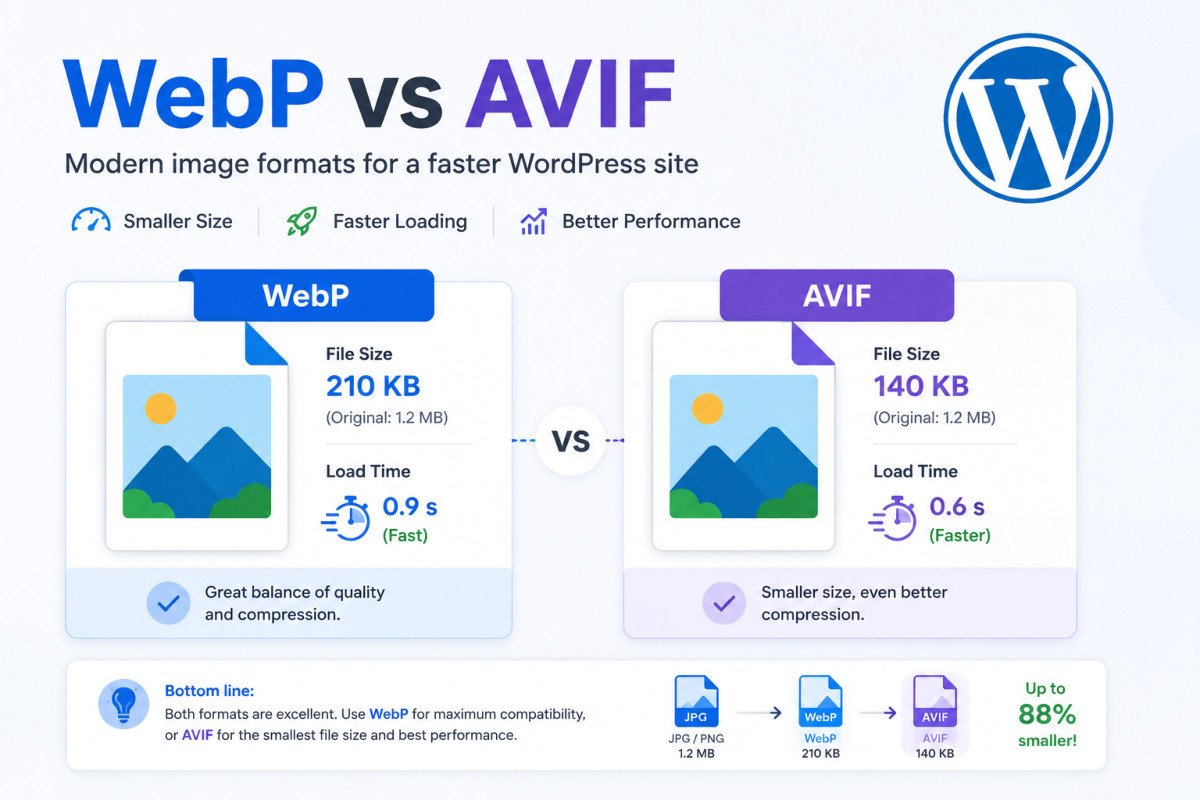
AVIF compresses images 20-50% smaller than WebP at equivalent visual quality, but it’s dramatically slower to encode, a conversion that takes under a second in WebP can take 10-40 seconds in AVIF. Browser support is close but not identical, WebP covers roughly 97% of browsers globally, AVIF around 93%. The practical answer for most WordPress sites: serve AVIF with a WebP fallback using the
Before You Start
See our broader image optimization guide first if you haven’t covered the fundamentals, resizing and compression plugins, this article goes deep specifically on the format decision itself.
“Just use AVIF, it’s smaller” is the kind of advice that sounds complete until you actually try converting a few hundred images and watch your build process grind to a halt. The real answer involves an actual trade-off, not just a bigger number winning.
What You’ll Learn
- The real compression numbers, and the encoding-speed trade-off nobody mentions upfront
- Where browser support genuinely still differs between the two formats
- The practical approach that lets you use both without picking just one
- Why a third format (JPEG XL) isn’t a real option yet, despite technical promise
The Core Trade-off: Compression vs. Encoding Speed
AVIF’s compression advantage is genuine and consistent across independent testing: typically 20-50% smaller file sizes than WebP at equivalent visual quality. On a real product page with 20 images, that kind of savings can mean over 2MB less data per page load, meaningful for both Largest Contentful Paint and bandwidth costs.
Here’s the trade-off that matters in practice: AVIF is dramatically slower to encode. A 2MB image that converts to WebP in under a second can take 10 to 40 seconds to encode as AVIF using standard settings. For a site converting 500 images through a build pipeline, that difference can add 20-30 minutes to the process. If you’re pre-encoding images once and serving them from a CDN afterward, this genuinely doesn’t matter, the slow part happens once, not on every visit. If you’re doing real-time, on-the-fly image processing, it matters considerably more.
Browser Support: Close, But Not Identical
As of 2026, WebP covers roughly 97% of browsers globally. AVIF sits around 93%, a real but narrowing gap, mostly accounted for by legacy Android devices and older Safari or iOS installations still in limited circulation. AVIF’s support has matured significantly and continues growing, but it hasn’t fully closed the gap yet.
Where Each Format’s Image Quality Shines
AVIF supports higher bit depth and HDR, genuinely producing more precise colors and better detail retention in complex, high-contrast photography. WebP tends to preserve smooth gradients cleanly and can show fewer compression artifacts at medium-quality lossy settings. In practice, both deliver excellent results for typical web use, the difference is usually only visible at very aggressive compression levels or in specific, demanding image types.
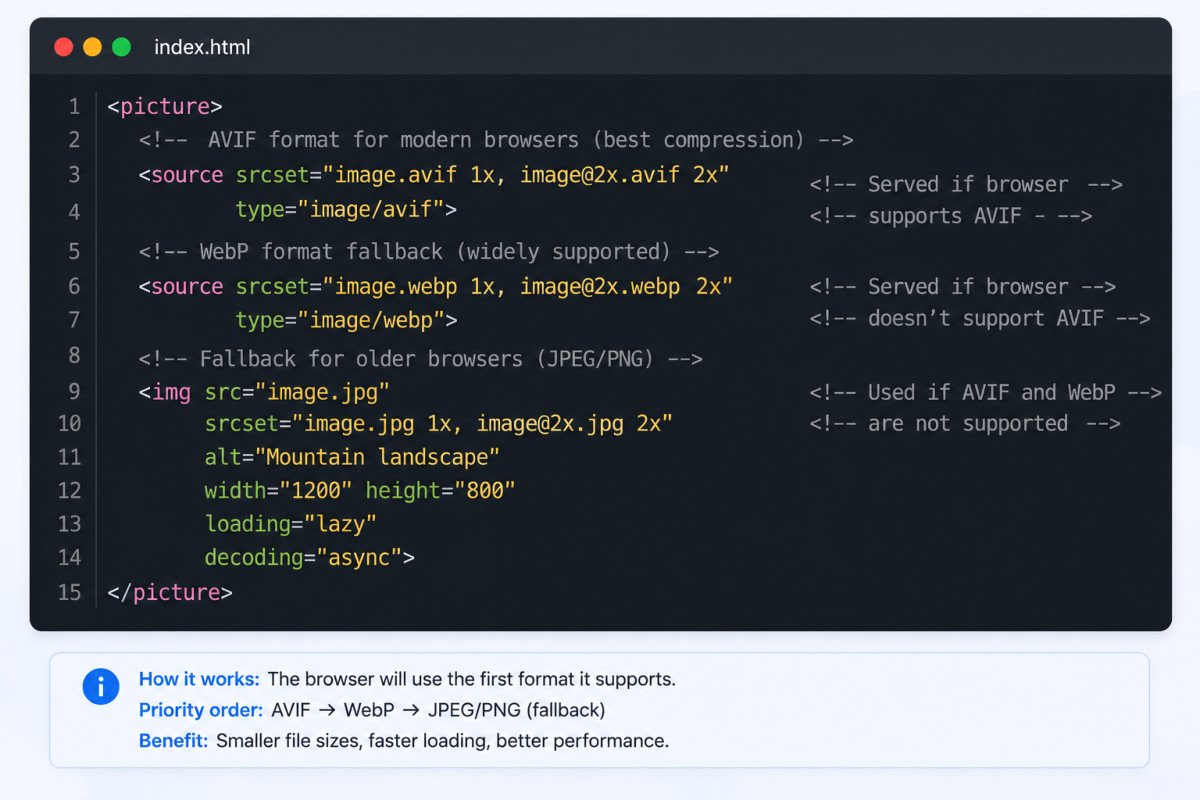
The Best Practical Approach: Serve Both
Rather than choosing one format exclusively, the widely recommended approach is serving AVIF with a WebP fallback using the HTML
A Third Option That Isn’t Ready Yet
JPEG XL is a genuinely impressive format technically, offering lossless JPEG recompression and progressive decoding neither WebP nor AVIF provide. But its real-world browser support sits at roughly 15% globally, and major browsers and CDNs don’t consistently support it yet. Worth knowing it exists, not worth building around today.
WebGomu Tip: If your compression plugin gives you a choice, let it handle the AVIF-with-WebP-fallback setup automatically rather than trying to manage this manually. The encoding-speed trade-off is exactly the kind of detail a well-built plugin abstracts away for you.
Which Should You Choose?
- Most WordPress sites: Let your compression plugin serve AVIF with WebP fallback automatically, the practical best-of-both approach.
- Large image libraries with real-time upload processing: Consider WebP-only if encoding speed genuinely becomes a bottleneck for your specific workflow.
- Photography-heavy or high-end visual sites: AVIF’s quality-per-byte advantage is worth prioritizing, since visual fidelity at small file sizes matters more here than elsewhere.
Common Mistakes
- Assuming AVIF is a strict upgrade over WebP without accounting for the real encoding-speed trade-off.
- Manually converting large image batches to AVIF without realizing how much longer it takes than WebP.
- Serving AVIF exclusively without a WebP fallback, breaking the experience for the roughly 7% of browsers that don’t yet support it.
- Building around JPEG XL for production use before it has meaningful real-world support.
Recommended Tools
- ShortPixel or Imagify — both handle AVIF-with-WebP-fallback automatically, see our image optimization guide
Key Takeaways
- AVIF compresses 20-50% smaller than WebP, but encodes dramatically slower, 10-40 seconds versus under a second per image.
- WebP covers roughly 97% of browsers, AVIF around 93%, a narrowing but real gap.
- The practical best approach is serving AVIF with a WebP fallback, most plugins handle this automatically.
- JPEG XL is technically promising but not ready for production use in 2026.
Frequently Asked Questions
Is AVIF always better than WebP?
Not universally. AVIF compresses better, but encodes dramatically slower, a real trade-off depending on your specific workflow, not a simple upgrade in every case.
Do all browsers support AVIF in 2026?
No, AVIF support sits around 93% globally, compared to roughly 97% for WebP. The gap is mostly legacy Android devices and older Safari or iOS versions.
Should I serve AVIF or WebP on my WordPress site?
The recommended practical approach is serving both, AVIF for browsers that support it, with an automatic WebP fallback for those that don’t, handled automatically by most image optimization plugins.
Why does AVIF take so much longer to encode than WebP?
AVIF’s compression algorithm, derived from the AV1 video codec, is significantly more computationally intensive, a trade-off for its superior compression results.
Is JPEG XL a real alternative to WebP and AVIF?
Not yet in practice. Despite genuine technical strengths, its browser support sits around 15% globally, with inconsistent support from major browsers and CDNs, making it unsuitable as a primary format today.
Resources Links
Author:

Christoper Enolpe
Founder of WebGomu • WordPress Freelancer with 10+ Years of Experience
Christoper is the founder of WebGomu and a WordPress freelancer with over 10 years of hands-on experience building, optimizing, and maintaining WordPress websites. He writes practical, beginner-friendly guides based on real-world experience, covering WordPress, SEO, website performance, and AI tools to help readers build better websites with confidence.
Learn more: https://webgomu.com/about/
Get one WordPress tip every week
Start Here
The Ultimate Beginner’s Guide to WordPress (2026): Build Your First Website Without Coding
Popular Guides
Our Partner

More from the blog
The Ultimate WordPress Speed Optimization Guide (2026)
The Ultimate WordPress Security Guide (2026)